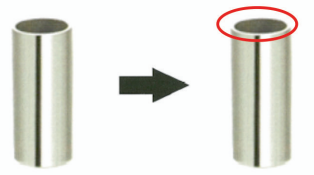
The pipe end deburring machine, model JSB-D1485, takes the raw cut end of a stainless steel tube and rolls it smooth. A cutting or dividing station leaves a raised burr and a slightly torn lip at the opening; this station works that edge down to an even, rounded end, so the tube moves on with a clean wall instead of a sharp rim.
Physically it is a compact floor-standing unit: a box base on adjustable feet, a vertical column carrying the working head, a push-button control panel at the front, and a hinged door that opens onto the head for setup and blade checks. Ventilation slots down the side let the pneumatic and electrical side breathe through long shifts. It does not need its own bay — it stands at working height beside the cutting station, and one operator loads, cycles and unloads.
Where it earns its keep is further down the line. In a vacuum flask line the tube ends are the first thing the bulging tooling touches, and a burr that goes in with the tube is pressed into the tooling and then into the next few hundred bodies that pass through it. Rolling the end smooth before bulging is a short extra handling step that protects expensive tooling and keeps the outside of the finished flask clean.
Running it is deliberately uncomplicated. The tube is seated against a locating stop and held in a clamping tool, then the pneumatic head brings the rotary blade to the end for a short cycle. Because the tube is clamped rather than hand-guided, the operator's hands stay clear of the blade once the cycle starts, and repeated ends come out the same shape. End position is the setting that matters most: once the tube sits square against the stop, the roll comes out uniform.
Plants add this station for different reasons — a die that wears too quickly, a witness mark that keeps appearing on polished bodies, a first-off inspection that keeps failing. The sections below take each of those in turn.
- Wide outside-diameter coverage. The working envelope covers the spread from slim cup bodies up to wide flask shells, so a product mix at both ends of the range can run on the same station rather than needing a second machine. - Full working length. Short blanks and long body tubes both fit. On the longest tubes it is handling, not the machine, that sets the pace. - Stainless steel tube, with wall thickness to confirm. The station is built for stainless tube; send us the wall you run on your thinnest and thickest products and we will confirm how the clamp and head should be set for them. - After cutting, before bulging. Tube arrives from the cutting or dividing station and leaves ready for water bulging. This unit does not cut tube to length and it does not form the body. - Not a seam roller. The weld-seam rolling station flattens the longitudinal seam running along the tube; this one works the cut ends. A line that needs both runs them as two separate steps, in sequence. - Built to join an existing sequence. As a vacuum flask line supplier we also build the cutting stations ahead of this one and the bulging stations behind it, so the handoff between them can be planned rather than improvised on the floor.
Deburring and Mold Life
A burr is a tooling problem before it is a looks problem. The raised edge at the tube end meets the bulge die before the smooth wall behind it does, so every burred tube takes a little more off the die surface than a clean one would.
Marks travel from tooling to product. A die or clamp that has picked up a burr imprint passes a witness mark on to the bodies it forms, and on a polished or brushed flask that mark is a reject at final inspection rather than a touch-up.
Mold life is counted in cycles, and burrs shorten it. A scored die has to be re-polished or replaced earlier than planned. Rolling the ends smooth keeps the contact surfaces clean so the die runs its intended life.
A uniform end bulges evenly. When the wall thickness at the opening is the same all round, the bulge opens symmetrically instead of stretching harder on one side, and the finished body measures and looks consistent.
Skipping the step moves the rejection downstream. A burr that survives this station usually shows up after bulging or polishing, when the part carries more labour and scrapping costs more.
Less hand work at the end of the line. Ends that reach polishing already clean need fewer touch-ups, and the rework loop that follows a burr problem disappears.
The running cost of stainless steel tube deburring is modest against the tooling bill. A short pneumatic cycle, one operator and no consumable beyond the blade, set against dies and rejected bodies.
Output and Operator Load
The published capacity is 8,000–10,000 pieces per eight-hour shift, and that band is realistic for a station that is fed steadily and kept in adjustment. Where you land inside it is decided by four things: the diameter and length of the tube, since a wide flask shell with a long body takes more handling than a short cup blank; the wall thickness; the condition of the blade; and above all the rhythm of the operator at the load position.
One operator runs the station. The cycle is pneumatic and short, so the work is load, clamp, cycle, unload, inspect, repeated. There is no second person at the machine and no manual force applied to the tube — which is the point. A hand-held deburring operation depends on how long someone is willing to hold a grinder against an edge, and that changes through a shift. A clamped, powered cycle does not.
The figure that matters when you plan a line is not this station's own rate but the rate of the slowest step around it. A pipe end deburring machine of this size normally keeps pace with the mechanical cutting station feeding it; if your upstream station is much faster, the buffer between the two decides whether that extra speed reaches the rest of the vacuum flask line. Tell us your line rate when you enquire and we will say plainly whether this station sits inside it.
The range also gives you room to absorb variation. On a batch that runs heavy on large-diameter tube, output per shift drops toward the lower end and the station still finishes the shift comfortably within its working envelope. Capacity is quoted as a band for exactly that reason, not as a fixed number every day.
Specifications
Model
JSB-D1485
Function
Rolling pipe ends smooth
Technology
Rotary blade cutting, pneumatic
Working length
0-850mm
Working pipe diameter
30-140mm
Cutting Speed
8000-10000pcs/8h
Voltage
380V~/415V~
Air pressure
0.6Mpa
Power
1.1KW
Size
860*800*1500MM
Weight
350KG
Application
Stainless steel tube deburring and end rolling for flasks and bottles
Installation and Site Requirements
Level the floor position first. This tube end rolling machine sits on adjustable feet, so a firm patch of floor beside the cutting station is enough — check that the front door swings fully open and that the control panel sits at a comfortable height for the operator who will run it.
Bring compressed air to the machine. A vacuum flask line normally has air on tap, but run a dedicated take-off to the station at 0.6 MPa and fit a filter-regulator at the machine rather than relying on the ring main; moisture and oil in the air are what shorten the life of pneumatic valves.
Connect the electrical supply to match the machine, which is built for 380V~ or 415V~. Confirm which your plant runs before the order is placed, because the machine is wired to that specification and not to a switchable range.
Set the stop and clamp for the first tube size. Seat a cut tube against the locating stop, close the clamp and check that the tube axis is square to the head; a tube sitting at an angle rolls an oval end no matter how carefully the blade is set.
Run a first-off batch of five to ten tubes and inspect the ends. Look for a smooth, even roll with no remaining lip on one side, and keep a known-good end as a reference sample at the station.
Train the operator on the sequence — seat, clamp, cycle, release, inspect — and on what a good end looks like. Most rejects at this station come from a tube that was not seated against the stop, not from the machine itself.
Agree the routine checks before handover: blade edge, clamp wear, air leaks, and a quick look at the first piece after every blade change.
Wear Parts and Head Care
The rotary blade is the part that wears out. In stainless steel tube deburring its edge dulls gradually rather than failing outright, and the first sign is usually an end that comes out with a slight lip on one side instead of an even roll.
Read the symptom before you touch any setting. A dull edge, a tube that was not seated square against the stop and a worn clamp pad all produce a poor end, and only one of them is cured by fitting a new blade. Check squareness and clamp condition first, then look at the cutting edge.
Do not raise the air pressure to force a dull blade through. A tube end rolling machine of this size is set to run at 0.6 MPa, and pushing the pressure up to compensate for a worn edge overloads the pneumatic side and hides the real problem instead of solving it.
Clamp faces and the locating stop are the second wear point. Every cycle presses the tube against them, so once the faces polish up or the stop creeps, the end sits fractionally off-centre and rolls unevenly. Inspect both whenever you check the blade, and re-check squareness after any work on the head.
Keep the air clean. A filter-regulator at the machine traps the moisture and oil that would otherwise reach the valves and cylinder; drain it weekly and change the element as part of routine service rather than waiting for the head to slow down or stick.
Blade changes should stay short. The hinged front door opens straight onto the head, so a spare blade on the shelf turns a change into a few minutes instead of a lost shift — order the spare with the machine rather than after the first dull edge.
Build a first spare kit around the parts you will actually consume: at least one spare rotary blade, a set of clamp pads, a filter-regulator element and seals for the pneumatic circuit. Confirm the exact contents with us when you order, since the list depends on how the station is set up for your tube sizes and wall thicknesses.
Log blade changes against pieces run. A pipe end deburring machine fed heavy-wall tube will use up edges faster than one running slim cup blanks, so the honest answer to how often is the one your own log produces after a few weeks. Until then, check the edge at the start of each shift and inspect the first end after every change.
Ordering and Delivery
Send the tube details first: outside diameter, wall thickness, cut length, material grade and the end condition coming off your cutting station. A photo of a typical cut end answers more than a specification sheet.
Tell us the supply voltage at your site — 380V~ or 415V~ — and the compressed air pressure you can hold at the machine, so the unit is configured for your plant rather than for a general case.
Say whether the tube end rolling machine is going in on its own or as part of a longer sequence. As a vacuum flask line supplier we can quote a single unit or plan it into a full pipe-making, cutting and bulging arrangement.
Agree the operating scope: what is supplied as standard, and whether you want us to handle installation, commissioning and operator training on site.
Every machine carries a one-year warranty. Keep the commissioning record and the first-off end sample — both help if a question comes up later.
Confirm packing, shipping terms and the lead time with your sales contact before dispatch. Export packing and delivery schedules depend on destination and order size, so they are agreed per order.
Ask for the documents your own team will need — layout drawing, utility requirements and the operating sequence — so maintenance has them before the machine lands.
Technical Support & Model Matching
Getting the right machine is the first step to a stable line. Since 2011, Shantou Jackson Machinery Co., Ltd. has built automatic equipment for hardware manufacturers from our base in Shantou, China, backed by ISO 9001:2008 certification and patented technologies. Our engineers start with your output target and plant layout, match models and options to the job, and confirm how new units connect to what you already run. After delivery we guide installation and commissioning, train your operators, and stay reachable for troubleshooting and spare parts. Equipment carries a one-year warranty.
FAQ
How is this different from a weld-seam rolling machine?
The seam roller works along the tube, pressing the longitudinal weld seam flat so later necking and spinning do not wrinkle the wall. This station works the cut ends: the burr and torn lip at the opening are rolled down to a smooth, even edge. A plant running both uses the seam roller after the tube is formed and this machine after the tube has been cut to length, before the ends are bulged.
How is the tube held while the end is being rolled?
In a clamping tool. The operator seats the tube against the locating stop and closes the clamp; the pneumatic head then brings the rotary blade to the end. Because the tube is held rather than hand-guided, the end comes out the same shape every cycle and the operator's hands are away from the blade once the cycle begins.
Will it handle my wall thickness and material?
It is built for stainless steel tube, and the working envelope is set out in the specifications. Wall thickness is the one figure worth confirming with us before the order — send the wall you run on your thinnest and thickest products and we will tell you how the clamp and head should be set for each.
What upkeep does the deburring head need?
The blade is the wear part. Keep the working end clean, check the edge at the start of a shift, and change the blade when ends stop coming out uniform or start showing a lip on one side. Ask us for the inspection interval that suits your tube grade and volume — how abrasive the material is and how many pieces you run both affect it.
Do I still need this station if my tube is laser cut?
A laser-cut end starts cleaner than one from a mechanical blade, so the need depends on what your bulging or necking stage expects from the opening. Send us a few laser-cut ends along with the finish your next step requires, and we will tell you whether the roll adds anything to your sequence or whether you can go straight to bulging.