Product Overview
Stainless tube reaches this station already welded and cut to length. This weld seam rolling machine uses a servo-driven pressing head to run the longitudinal weld seam flat and smooth, so the shell leaves ready for necking, spinning, threading and polishing. It is a whole-line machine, not a bench roller: it expects automatic pipe making and cutting upstream, and it hands finished tube straight to the next forming stage.
Factories running thermos shells, vacuum bottles, water bottles, cups and kettle bodies buy it because the seam is the first thing their downstream tooling touches. A raised weld comes back later as a wrinkle in the neck, a mark on the shoulder, or a polishing line that will not disappear — flattening it before those steps costs far less than repairing it afterwards.
As a vacuum flask line supplier, we build the station to sit inside your automatic pipe making and cutting line rather than stand alone on a factory floor. The manipulator is mounted and wired at our works, so the machine arrives as one assembly instead of two systems to marry on site. The enclosure is a white cabinet with double glass doors and a side access opening, which lets an operator watch the seam being pressed and reach the head without pulling panels off.
The machine suits plants running medium-to-high volume across continuous shifts. A workshop cutting a few hundred tubes a week will not recover the value of the automation; a line feeding necking, spinning and polishing stations every hour will.
Line Position & Process Flow
- Welded tube in. The station takes stainless steel tube from the pipe making unit of your stainless steel tube production line, already closed along its length and ready for the seam to be pressed.
- Cut to length. The cutting station divides the tube to the length your product needs before it reaches the rolling head.
- Automatic transfer. The integrated manipulator picks the cut tube and positions it at the head. Nobody lifts or lines it up by hand, and because the manipulator is built into the machine at our factory, there is no separate manipulator installation and debugging on your floor.
- Seam alignment. The pressing wheel is brought onto the longitudinal seam, and the operator confirms the seam sits under the wheel before the cycle starts.
- Rolling pass. The servo head travels the seam and presses the weld into the wall until the joint is level with the surrounding surface.
- Hand-off downstream. The tube leaves for neck and mouth forming, spinning, threading, polishing or hydro-forming, with no raised line left for those tools to catch on.
Seam Quality & Control
Seam quality comes down to two things: where the wheel sits and how steadily it is fed along the joint. Both are handled electrically here. A servo system drives the head and the feed, and a PLC holds the rolling parameters, so the pressure and speed that produced a good first-off sample are the same pressure and speed on the last tube of the shift.
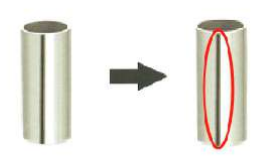
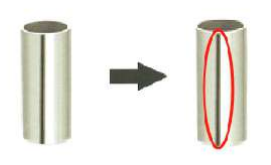
On the tube itself the change is easy to see. Before rolling, the weld shows as a raised line down the shell, picked out in red in the close-up; after rolling it is flush with the wall — flat, smooth and continuous along the full working length. Inspectors check it by eye and by hand, and the difference really shows once the surface is polished.
Consistency matters most on thin wall. A seam pressed too hard on a thin shell thins the wall or leaves a ripple; pressed too lightly it stays proud and returns as a wrinkle during necking. Because the PLC holds the setting instead of relying on operator feel, the same tube size runs the same way across shifts and across operators, which is what high-volume production actually needs.
The payoff sits downstream. Neck and mouth forming, spinning, threading and polishing all work on a tube that is round and even at the joint, so a flattened seam is the difference between a shoulder that forms cleanly and one that wrinkles or breaks at the weld line.
Tube Sizes & Product Fit
- Diameter window. Working pipe diameter runs from 40 mm to 180 mm, covering slim vacuum bottle shells through wide kettle and pot bodies on one machine.
- Length window. Working length runs from 100 mm to 800 mm, so short cup blanks and tall flask bodies both fit the same head.
- Small end of the range. At the slim end the station handles bottle shells and tumbler blanks, where a proud seam is most obvious after polishing.
- Large end of the range. At the wide end it covers wide-mouth flasks, kettle bodies and pot shells, where the rolling head needs real force to press the joint into a heavier wall.
- Wall thickness. Strong rolling force works on thin and thick material both: thin-wall tube is pressed without a separate light-duty setup, and heavy-wall tube does not stall the head on a stainless steel tube production line.
- Product families. Thermos and vacuum flask shells, water bottles, vacuum cups and kettle bodies — anything built from a welded stainless round tube that has to show no visible weld line before forming.
- Before you order. If your tube diameter or length sits outside these two windows, send us the size and the product first — as a vacuum flask line supplier we would rather point you to the right station than sell the wrong one.
Material Compatibility
Stainless steel is the confirmed material. On a vacuum flask line the tube material is settled long before this station is specified, and stainless steel is what this weld seam rolling machine is built for: it presses a longitudinal weld flat into the wall, so pressing force, wheel profile and feed rate are all set around stainless steel tube arriving from a welding line. Other metals need checking first. Copper and aluminium do appear elsewhere in our equipment range — the pipe dividing station is specified to cut them — but that does not make them a drop-in material for seam rolling. Both are softer and more ductile than stainless, so a force that levels a stainless weld can mark the surface, thin the wall or push the tube out of round. We would rather check than have you plan a production run on an assumption: send the material and wall thickness and our engineers will tell you whether this head can run it, what it would need, or whether the blank belongs on a different station. What to send with your enquiry. Four details decide the answer: the material grade, the wall thickness, the tube diameter and length, and how the seam was made — welded or drawn. Send them with a short sample length taken from your own automatic pipe making and cutting line, and our engineers can check the pressing wheel and force setting against the real blank before the machine is built. If you intend to run stainless and another metal on the same stainless steel tube production line, say so at order stage: switching material means re-setting the head and may mean a different wheel, so it is a planned change, not a switch. Nothing outside stainless steel should be treated as confirmed until we have answered for your material.
Manpower & Day-to-Day Running
- One operator per station. On a vacuum flask line running continuous shifts, one operator sets the head and checks the seam while the manipulator handles the transfer.
- Fewer hands between steps. Because making, cutting and rolling are joined on an automatic pipe making and cutting line, the handling tasks that used to sit between those stations disappear along with the people assigned to them.
- Servo drive, low maintenance. The head is positioned electrically rather than through a chain of manual adjustments, and the design is deliberately low-maintenance: routine work is inspection and cleaning, not rebuilds.
- Daily check. Look over the pressing wheel surface for scoring, wipe metal dust away from the guide and roller area, and confirm the seam sits cleanly under the wheel on the first tube of the shift.
- Spares worth holding. Pressing wheel and roller assembly, a servo drive and a PLC module are the parts that stop a line; agree the recommended spares list with us at handover so a replacement never waits on a shipment.
Specifications
| Property | Value |
|---|
| Model | JSB-AR800 |
| Control | PLC |
| Production capacity | 3000-5000 pcs/8h |
| Voltage | AC380V |
| Power | 6.1 kw |
| Dimensions | 2655 × 1000 × 1986 mm |
| Weight | 1500 kg |
| Material suitability | Thin and thick stainless steel tube |
| Clamping | Robust clamping force |
| Maintenance | Low-maintenance design |
Installation & Commissioning
- Share the line layout early. Send the tube sizes you run and the position of your pipe making and cutting stations before the machine is built, so the engineers can agree how the new unit connects upstream and downstream.
- Prepare the floor. The machine stands on its own adjustable leveling feet, so the area needs to be level and clear enough for the glass doors and the side opening to swing fully.
- Set and level. The unit is landed, set on its feet and levelled so the enclosure stays square and the head tracks the seam accurately along the whole working length.
- Connect power and controls. Electrical connection follows the supply specified for the machine, with the control cabinet already wired and integrated as one assembly from the factory.
- Dry run first. Run the cycle without tube to check the manipulator handshake, the head travel and the safety interlocks before any product goes through.
- Tune on your own tube. We run the sizes you actually make and tune rolling pressure and feed rates until the seam comes out flat and smooth, then record that setting as the starting point for each product.
- Train the operators. Training happens at commissioning on your tube sizes — loading, seam alignment, first-off inspection and the daily checks the shift will repeat.
Ordering & Delivery
| Order route | Quotation, specification sign-off and order confirmation with your sales contact |
| Warranty | One-year warranty after installation |
| Installation | On-site installation and commissioning, scheduled to your line start-up |
| Operator training | Delivered during commissioning on the tube sizes you run |
| Payment terms | Agreed with your sales contact at order confirmation |
| Lead time | Confirmed against your line schedule when the order is placed |
| Packing and shipping | Export packing and freight terms confirmed with your sales contact |
| Spare parts | Pressing wheel and roller assemblies, servo drives and PLC modules supplied against the original build |
Technical Support & Model Matching
Getting the right machine is the first step to a stable line. Since 2011, Shantou Jackson Machinery Co., Ltd. has built automatic equipment for hardware manufacturers from our base in Shantou, China, backed by ISO 9001:2008 certification and patented technologies. Our engineers start with your output target and plant layout, match models and options to the job, and confirm how new units connect to what you already run. After delivery we guide installation and commissioning, train your operators, and stay reachable for troubleshooting and spare parts. Equipment carries a one-year warranty.
FAQ
What pipe sizes and lengths can this machine handle?
The station covers slim vacuum bottle shells through wide kettle and pot bodies, and short cup blanks through tall flask bodies, all on one head. Exact diameter and length windows are listed under Tube Sizes & Product Fit, and if your product sits outside them, a quick size check with us before ordering will confirm whether this model is the right starting point.
Can it be connected to the pipe making and cutting equipment we already run?
Yes. The station is built to join existing equipment, and we customize the connection — rolling pressure, feed rates and the interfaces to your upstream pipe making and downstream cutting or forming machines — so the stages run as one process. As a vacuum flask line supplier working with lines that are often already producing, we usually start from the layout and make of the neighbouring machines, so tell us those details when you enquire.
How does the machine keep the weld seam consistent at high volume?
Servo control drives the head and its feed, and a PLC holds the pressure and speed settings, so the seam is rolled the same way on the first tube of a shift and on the thousandth. Because the setting is held electronically rather than by operator feel, it stays stable when you switch from one wall thickness to another.
What maintenance and technical support come with the machine?
The design keeps maintenance light: a servo-driven head, few manual adjustments, and access through the glass doors and side opening for inspection and cleaning. Your operators are trained during commissioning on the sizes you run, and our engineers stay reachable afterwards for troubleshooting and spare parts.
Can the line run copper or aluminium tube as well as stainless steel?
This station is built around the stainless steel tube that comes off the welding line, which is where most flask and bottle production starts. If you also plan to run copper or aluminium blanks, describe the material and wall thickness before ordering so we can confirm what the rolling head needs for it.